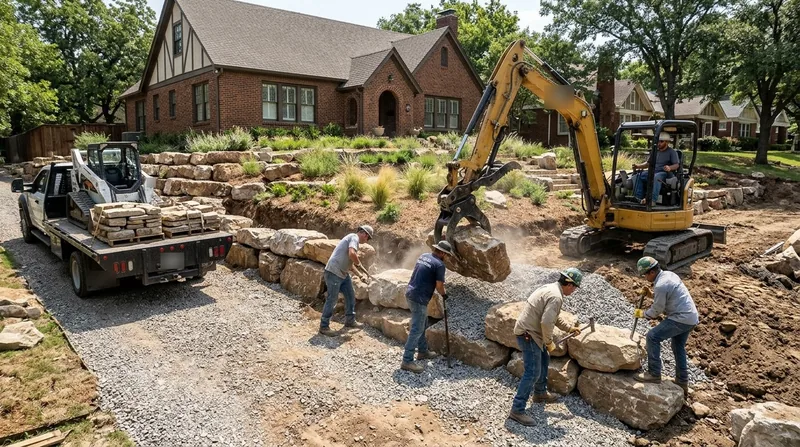




Boulder and natural stone walls in Dallas blend seamlessly into the sloped terrain and creek-side landscaping that define the city's older neighborhoods and newer subdivisions alike. From the limestone bluffs above the Trinity River in Oak Cliff to the ravine-cut lots along White Rock Creek in Lake Highlands, Dallas homeowners face unique challenges: black Blackland Prairie clay that swells in spring downpours and shrinks in summer drought, Austin Chalk limestone bedrock just below the surface, and aging timber and segmental walls that fail under seasonal stress. A well-built boulder or natural stone retaining wall handles that cycle without cracking or leaning, while adding authentic character to your property. We install, repair, and replace these walls with proper base preparation, drainage, and machine-placed stone that lasts decades in Dallas weather.
Why Boulder and Natural Stone Walls Matter in Dallas Terrain
Dallas sits on unstable clay over limestone, and that combination creates real pressure on retaining walls. Spring and early summer rains saturate the soil, causing it to swell and push against walls with tremendous force. By mid-summer, the same clay shrinks and cracks, leaving gaps for water to infiltrate and freeze in winter, accelerating failure. Boulder and natural stone walls, when built with proper drainage and base preparation, resist this cycle far better than timber or aging segmental block because they shed water, settle uniformly, and distribute load across their mass rather than concentrating it on a single structural line.
- Boulder walls handle the Dallas clay swell-and-shrink cycle without cracking or bowing inward.
- Natural stone blends into creekside and ravine landscapes, restoring the look of original Blackland Prairie terrain.
- Proper drainage behind the wall prevents water buildup that causes leaning and collapse in older timber and block walls.
- Stone walls require no paint, staining, or chemical treatment, so they stay maintenance-free through decades of Dallas heat and humidity.
If you have a sloped lot near a creek or ravine, or you're replacing a failed timber or block wall, natural stone is the material choice for Dallas.
Key info: Many Dallas neighborhoods, especially in Oak Cliff, Lakewood, and the M Streets, sit on steep lots with limestone outcrops and Trinity River bluffs. These properties often show failed railroad tie walls or leaning segmental block. Boulder and natural stone walls restore stability and authenticity to these historic settings. Always verify setback and property-line rules with your local city or HOA before construction begins.
For more detail on how we repair leaning and collapsed walls, see our leaning and collapsed wall repair page.
How We Build Boulder and Natural Stone Walls in Dallas: Our Process
We start every boulder and natural stone wall project with a site walk and soil assessment. We identify the grade change, measure the height and length, note any existing drainage problems, and check for utilities and property lines. From there, we excavate a proper footing below the frost line, compact the base, install perimeter drainage, and position stone using a mini excavator or loader. The result is a wall that sits solidly on undisturbed or properly compacted soil, sheds water away from the structure, and looks as natural as the bedrock it rests on.
- We assess soil type, slope angle, and drainage needs during the initial site visit.
- We excavate a stable footing below frost depth and compact the base to prevent settling.
- We install perimeter drain tile and a filter fabric barrier to manage water behind the wall.
- We position each stone with a machine to create a stable, tiered face that sheds water naturally.
- We backfill behind the wall with compacted gravel and topsoil, then grade and stabilize the slope.
This step-by-step approach prevents the water damage and settlement that cause older walls to lean or fail.
Example: A homeowner in Richardson had a 15-year-old railroad tie wall that was leaning and rotting at the base. The clay behind it was saturated and swelling every spring. We removed the ties, excavated a proper footing, installed drain tile, and built a 4-foot boulder wall in its place. The new wall settled within the first season and has stayed plumb and dry for five years.
Read more about retaining wall drainage solutions and how drainage prevents future failure.
Boulder and Natural Stone Wall Methods: Choosing the Right Approach
Not all boulder and natural stone walls are built the same. The method we choose depends on your site, the height of the wall, the soil type, and whether the wall will support a surcharge such as a driveway or structure. Below is a guide to the main approaches we use in the Dallas area.
| Approach | Description | Best for |
|---|---|---|
| Machine-placed boulders | Large, irregularly shaped Texas limestone or granite boulders positioned with an excavator to create a gravity wall that sheds water and settles as one mass. | Sloped residential lots, creekside landscapes, 3 to 6 foot walls that do not support a structure. |
| Natural stone veneer over core | A structural core of compacted stone or recycled concrete, faced with cut or natural Texas limestone to create a finished look while distributing load evenly. | Taller walls (5 to 8 feet), walls that support a driveway or light structure, sites with poor soil. |
| Dry-stacked natural stone | Carefully fitted cut limestone blocks stacked without mortar, relying on weight and friction to hold. Requires expert placement and excellent drainage. | Historic or aesthetic applications, shorter walls in stable soil, areas where mortar cracking is a concern. |
| Mortared stone with engineered base | Cut or semi-finished natural stone set in mortar over a compacted stone or concrete footing, reinforced with drainage and geotextile for maximum durability. | Walls over 6 feet, engineered or permitted projects, walls supporting structures or driveways in clay soil. |
Each method has trade-offs in cost, labor, and long-term performance. We recommend the approach that fits your site, budget, and the local Dallas building code.
Boulder and Natural Stone Walls Cost in Dallas: What to Expect
Boulder and natural stone retaining walls in Dallas start at $25 per square foot for a simple gravity wall built on stable soil with good access. That baseline covers excavation, a proper footing, drainage, stone placement, and backfill. The final price depends on several real-world factors: the height and length of the wall, the type and size of stone you choose, soil conditions (clay versus sandy soil, presence of rock), access (whether a truck or loader can reach the site), and whether the wall requires an engineered design or a permit.
A 4-foot boulder wall 30 feet long on a typical Dallas lot with decent access might run $3,000 to $5,000. A taller, mortared stone wall with engineered drainage in a difficult site can exceed $10,000 to $15,000. Walls that support a structure or driveway, or walls in poor soil that require a reinforced core, cost more because they demand additional engineering and labor.
We always recommend getting 2 to 3 estimates from licensed contractors. Each site is different, and a good estimate includes a site visit, soil notes, and a clear list of what's included in the price. Never trust a quote given over the phone without seeing the property.
For a detailed pricing breakdown across wall types and sizes, visit our full pricing page.
Boulder and Natural Stone Walls Near Me: What Dallas Homeowners Should Know When Hiring
Hiring the right contractor for a boulder or natural stone wall is as important as choosing the material itself. A poorly built wall will fail in a few years, while a well-built one lasts decades. Here's what to look for when you're searching for a retaining wall contractor near Dallas or in surrounding areas like Plano, Garland, or Irving.
Verify licensing and insurance. Licensed contractors are bonded and accountable; unlicensed operators leave you liable if someone is injured on the job.
Get multiple estimates and check references. Call at least two other homeowners who had similar work done. Ask how long the wall has held up, whether it's stayed plumb, and whether the contractor was responsive and professional.
Understand permitting requirements. In many Dallas jurisdictions, walls above 4 feet or walls that support a surcharge (driveway, structure, or utilities) require a permit and possibly an engineered design. A good contractor will clarify these rules upfront and coordinate with the local building department. Never hire someone who says they can skip permitting to save money.
Ask about drainage and footing depth. A contractor who explains soil type, frost depth, and drainage strategy is one who understands why walls fail in Dallas. If they can't articulate this, move on.
Check HOA rules. If your property is in a deed-restricted community, the HOA may have rules about wall height, material, setbacks, or color. Confirm these before you sign a contract.
For a free, no-obligation estimate from a licensed, insured Dallas retaining wall contractor, contact us today or call (469) 436-3386. We respond within 24 hours.
Boulder & Natural Stone Walls in Dallas: Pricing Guide
| Service | Price | Details |
|---|---|---|
| Simple gravity boulder wall, 3 to 4 feet | Starting at $25/sq ft | Includes footing, drainage, stone placement, and backfill on stable soil with good equipment access |
| Taller or mortared natural stone wall, 5 to 8 feet | Starting at $35 to $50/sq ft | Includes engineered footing, reinforced drainage, mortared stone facing, and professional grading for durability |
| Wall supporting a driveway or structure | Starting at $45 to $65/sq ft | Includes engineered design, reinforced core, professional drainage system, and possible permit coordination |
| Complex or large-scale project (over 200 linear feet or unusual soil) | On estimate | Site-specific assessment required to account for soil type, access constraints, and structural load requirements |
| Travel and site visit | Included | No separate mileage or call-out fee within Dallas and surrounding service areas |
| Estimate | Free | Response within 24 hours at (469) 436-3386, no obligation to book, includes site walk and photo documentation |
Indicative pricing, the exact cost depends on square footage, finish, and site access. Free personalized estimate within 24h at (469) 436-3386.


