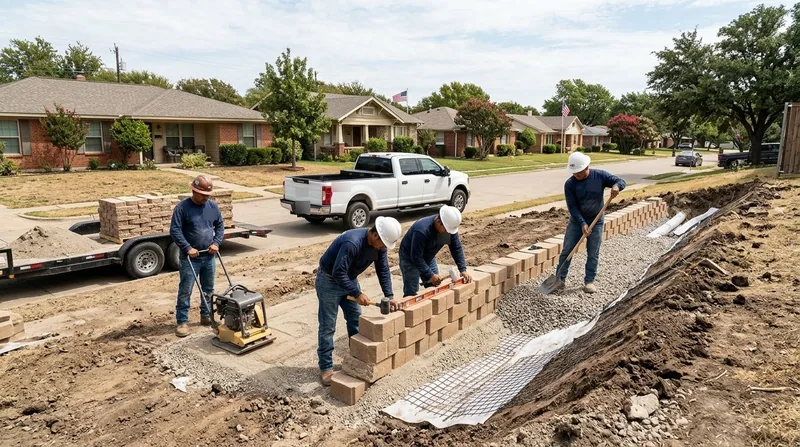




Retaining wall installation in Dallas requires more than standard construction. The Blackland Prairie clay that underlies Dallas, Plano, Garland, and Irving swells dramatically in spring rains and shrinks in summer drought, exerting lateral pressure that can push an undersized or poorly drained wall out of plumb within months. Dallas Retaining Wall installs new walls with deep footings, engineered drainage, and gravel backfill designed to resist the specific soil and water conditions that dominate the Trinity River basin and its tributaries. Whether you're grading a sloped lot in Lakewood, building terraced gardens in Oak Cliff, or stabilizing a driveway embankment in McKinney, a properly installed retaining wall stops soil movement before it starts.
Why Retaining Wall Installation Matters in Dallas: Clay Pressure and Drainage
Dallas sits on Blackland Prairie clay over Austin Chalk limestone, a geology that creates predictable failure patterns. Spring storms saturate the clay, increasing hydrostatic pressure behind any wall that lacks proper drainage. Summer heat and drought cause the same clay to shrink, opening cracks and allowing water to pool behind the wall during the next rainfall cycle. Without deep footings and gravel backfill, walls tilt, crack, or fail entirely within 3 to 5 years. New construction that addresses these conditions from the start avoids costly repairs and keeps soil in place for decades.
- We set footings below the frost line and stable clay layer to prevent heave and settlement.
- We install perforated drain pipe behind the wall and gravel backfill to move water away from the soil mass.
- We compact subgrade and backfill in lifts to ensure uniform bearing and drainage performance.
- We design walls to match the lot slope, building setbacks, and property-line requirements specific to your Dallas neighborhood.
Proper installation eliminates the foundation shifts and hydrostatic pressure that cause the majority of retaining wall failures in North Texas.
Key info: Walls taller than 4 feet or supporting a surcharge (driveway, structure, or fill) typically require a permit from your city's building department. Dallas, Plano, Garland, Irving, and other municipalities in Dallas County have different thresholds. We verify permitting requirements for your site and handle the process, but always defer to your local building department for final approval.
For more detail on wall failure and repair, see our Leaning and Collapsed Wall Repair page.
How We Install Retaining Walls in Dallas: A Step-by-Step Process
Installation begins with an on-site assessment of soil conditions, drainage patterns, and grade. We measure the slope, identify the water table and clay layer depth, and confirm setback and property-line compliance with local codes. From there, we build the wall in a sequence designed to lock it into place and manage water pressure from the moment the first course is set.
- We excavate the footing trench to stable soil below the seasonal frost line and active clay layer.
- We set the footing, compact the subgrade, and verify elevation and level before placing the first course.
- We build the wall face (concrete, block, stone, or timber) with proper batter (backward lean) to resist lateral pressure.
- We install perforated drain pipe at the wall base, running the full length and sloped to daylight or to a catch basin.
- We backfill behind the wall with gravel, then topsoil, compacting each lift to prevent settling and voids.
- We grade the surface to direct rainwater away from the wall and verify drainage flow before final inspection.
This sequence ensures the wall drains from day one and settles uniformly as the backfill compacts over time.
Local example: A homeowner in Richardson grades a lot to build a terraced garden. The existing slope is 1 foot per 4 feet of horizontal distance, and the top of the lot is 8 feet above the finished patio level. We install a tiered wall system with two 4-foot walls, each with independent footings and drainage. The lower wall rests on stable clay; the upper wall sits on engineered fill from the first terrace. Both walls are backfilled with gravel and drain pipe, sloped to a French drain that runs to the street storm drain. The result is a stable, level planting area that sheds water and resists the clay pressure that would otherwise push the slope back to its original angle.
For drainage-specific concerns, see our Retaining Wall Drainage service page.
| Approach | Description | Best for |
|---|---|---|
| Concrete Retaining Wall | Poured concrete monolith or precast concrete panels. High compressive strength, resists Blackland clay pressure, finished with stain or paint. | High-load applications, driveways, steep slopes, long-term durability in Dallas clay. |
| Block & Segmental Retaining Wall | Stacked segmental retaining wall (SRW) blocks, often reinforced with geogrid. Modular, flexible, aesthetic finish options. | Terraced gardens, moderate slopes, residential lots in Plano, Carrollton, and Frisco. |
| Boulder & Natural Stone Wall | Large stacked boulders or cut limestone blocks. Aesthetic, blends with local landscape, high initial cost. | Premium residential, landscape focal points, properties in Lakewood and Oak Cliff. |
| Timber Retaining Wall | Pressure-treated lumber or composite timber. Warm appearance, moderate cost, requires periodic maintenance and drainage. | Lower walls (under 4 feet), ranch-style homes, temporary terracing, budget-conscious projects. |
Retaining Wall Installation Cost in Dallas: What to Expect
Retaining wall installation costs in Dallas start at $30 per square foot for simple timber or standard block walls on level or gently sloped sites. Concrete walls, tiered systems, and complex drainage requirements typically run $40 to $60 per square foot. A 100-square-foot wall (roughly 25 feet long and 4 feet tall) can range from $3,000 for basic timber to $6,000 for engineered concrete with full drainage and backfill. Several factors move the price up or down.
- Wall height and length directly determine the volume of materials and labor required to build and backfill.
- Soil conditions and footing depth increase cost if stable bearing is deep or if existing fill must be removed and replaced.
- Material choice (timber, block, concrete, stone) affects unit cost and the time required to set each course.
- Drainage and gravel backfill are essential in Dallas clay and are included in a complete estimate, not optional add-ons.
- Site access and equipment mobility can raise cost if the lot is narrow, heavily landscaped, or requires hand-digging near utilities.
- Permitting and engineered drawings, required for walls over 4 feet or supporting a surcharge, add $500 to $2,000 depending on complexity.
Getting two or three estimates from licensed contractors in Dallas, Plano, or your neighborhood allows you to compare scope, materials, and warranty. See our full pricing guide for detailed breakdowns by material and application.
Retaining Wall Installation Near Me: What Dallas Homeowners Should Know When Hiring a Contractor
Choosing the right contractor for retaining wall installation in Dallas, Mesquite, Richardson, or any North Texas neighborhood protects your investment and ensures compliance with local codes. A qualified contractor understands Blackland Prairie clay, drainage requirements, and the specific permitting thresholds in your city. Before you sign, verify a few critical details.
- Confirm the contractor is licensed and insured, with current liability and workers compensation coverage available on request.
- Ask for references from recent projects in your neighborhood or similar soil conditions, and follow up with at least two homeowners.
- Verify that the contractor understands your city's permitting requirements and will handle or coordinate engineered drawings if your wall exceeds 4 feet or supports a surcharge.
- Get a written estimate that itemizes materials, labor, drainage, backfill, and any permitting fees so you can compare apples to apples.
- Confirm that the contractor drains the wall properly, uses gravel backfill, and compacts each lift, not just piles soil behind the wall.
- Ask about warranty coverage on materials and workmanship, and what happens if the wall settles or tilts within the first year.
We provide free estimates within 24 hours and handle all permitting and design coordination with your local building department. Contact us today for a no-obligation assessment of your lot and a detailed proposal tailored to your soil, slope, and material preferences.
Retaining Wall Installation in Dallas: Pricing Guide
| Service | Price | Details |
|---|---|---|
| Timber Retaining Wall | Starting at $30/sq ft | Pressure-treated lumber, simple design, suitable for walls under 4 feet on stable, well-drained sites in Dallas |
| Block & Segmental Retaining Wall | Starting at $40/sq ft | Stacked segmental blocks, geogrid reinforcement, gravel backfill, and drainage pipe included for terraced residential lots |
| Concrete Retaining Wall | Starting at $50/sq ft | Poured concrete or precast panels, deep footing, full drainage system, engineered for Blackland clay pressure and long-term durability |
| Boulder & Natural Stone Wall | Starting at $60/sq ft | Large stacked boulders or cut limestone blocks, premium finish, full drainage, engineered footing, and landscape integration |
| Tiered or Complex Installation | On estimate | Multiple walls, steep slopes, engineered drawings, or challenging site access require on-site assessment before pricing is given |
| Free Estimate & Design Consultation | No charge | Response within 24 hours, site visit, material options, and written proposal with no obligation to book service |
Indicative pricing, the exact cost depends on square footage, finish, and site access. Free personalized estimate within 24h at (469) 436-3386.


