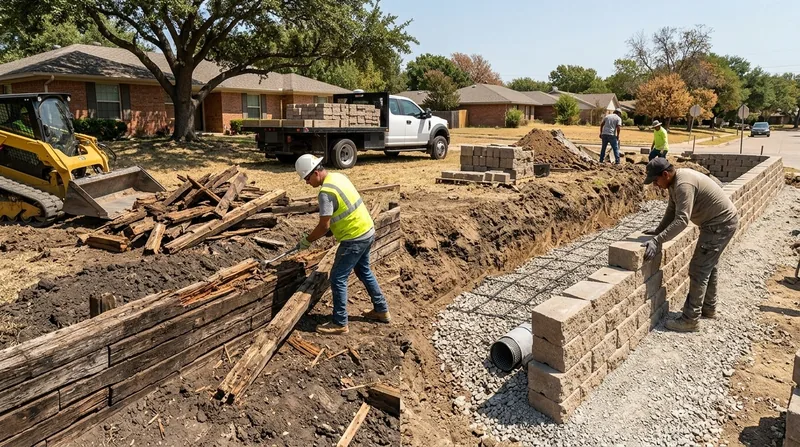




Retaining wall replacement in Dallas is one of the most common landscape repairs we handle, especially across the older neighborhoods where railroad tie walls and landscape timber barriers are failing after 20 to 30 years of exposure to our brutal clay-soil cycles. The Blackland Prairie clay that underlies Dallas swells dramatically during spring rains and shrinks and cracks under the intense summer drought, putting enormous lateral pressure on aging walls and causing them to lean, bulge, or collapse entirely. When a wall reaches the end of its life, half-measures do not work. A full tear-out and replacement with modern drainage and engineered materials is the only durable fix. We demolish the failed structure, haul away all debris, install proper base preparation and drainage systems, and build a new wall that will handle Dallas weather for decades to come. Whether your wall is rotting timber, crumbling concrete, or settling block, we have the equipment and expertise to replace it right.
Why Retaining Wall Replacement Matters in Dallas: Clay, Weather, and Structural Failure
Dallas homeowners often assume a leaning or cracked retaining wall can be patched or reinforced, but the reality is different. Once a wall has begun to fail, the forces acting on it from our expansive clay soil are relentless. Spring storms saturate the soil behind the wall, adding hydrostatic pressure that no patch can resist. Summer heat dries the clay to concrete-like hardness, creating voids and shifting the entire structure. A failed wall is not just an eyesore, it is a liability, a safety hazard to anyone on the property, and a threat to your landscaping, driveway, or foundation if the wall is positioned near your home. Replacement stops the damage before it spreads.
- We remove the entire failed wall structure, including all subsurface footings and compromised material.
- We excavate and prepare a proper base, compacting soil and setting a stable footing below the frost line.
- We install a drainage system behind the new wall to prevent water buildup and hydrostatic pressure.
- We build the new wall using engineered materials, whether poured concrete, segmental block, or natural stone.
- We grade and finish the surrounding landscape to direct water away from the wall and your property.
Each of these steps is essential to a wall that will perform for 30 years or more in Dallas conditions.
Key info: Dallas requires a permit for retaining walls above roughly 4 feet measured from the footing, or when a wall supports a surcharge such as a driveway or structure. Engineered drawings may be required for tall or tiered walls. Always verify current setback and property-line rules with your local building department. We handle all permitting and coordinate with inspectors throughout the replacement process.
For more detail on repair versus replacement, see our page on retaining wall repair in Dallas, which covers when reinforcement is possible and when replacement is the only safe option.
How We Replace a Retaining Wall in Dallas: Step-by-Step Process
A professional replacement job follows a proven sequence that ensures the new wall will be stable, properly drained, and built to code. We start with a site assessment to understand soil conditions, water flow, and any structures or utilities near the wall. We then obtain the necessary permits and schedule the work around weather and your availability. Demolition and haul-away come next, followed by base preparation, drainage installation, and finally the construction of the new wall. The entire process typically takes one to three weeks depending on wall length, height, and the material you choose.
- We inspect the existing wall, identify all failure points, and confirm the extent of subsurface damage and soil settlement.
- We obtain all required permits and schedule an inspection appointment with the local building department before we begin.
- We demolish the old wall using excavation equipment and remove all debris, concrete, and timber from the site.
- We excavate the base, compact the soil to specifications, and set a proper footing that extends below the frost line.
- We install a perforated drainage pipe and filter fabric to manage water pressure and prevent future saturation.
- We construct the new wall using your chosen material, set in proper alignment and backfilled with compacted soil and gravel.
- We schedule a final inspection with the building department and provide you with all permits and documentation.
This methodical approach eliminates the root causes of wall failure and gives you a long-term solution.
Local example: A homeowner in Lake Highlands with a 45-foot-long railroad tie wall behind a 1960s ranch had the wall replaced with segmental block and new drainage over the course of 10 days. The old ties were rotting and leaning inward by 8 inches. After replacement, the property regained its usable backyard space, and the new wall has settled perfectly through two full seasonal cycles of expansion and contraction.
Learn more about material options on our page covering block and segmental retaining walls in Dallas.
Replacement Methods and Materials: Choosing the Right Solution for Your Dallas Property
The best material for your replacement wall depends on your budget, aesthetic preferences, the height and length of the wall, and site-specific soil and drainage conditions. Poured concrete is durable and economical for tall walls. Segmental block offers flexibility and a cleaner appearance. Natural stone provides timeless beauty and works well on visible slopes. Each method has distinct advantages and cost implications, and we help you weigh them against your goals and timeline.
| Approach | Description | Best for |
|---|---|---|
| Poured Concrete | Monolithic concrete wall cast in place with reinforcing steel, proper drainage, and finished with a texture or color seal. Highly engineered and inspected at each pour stage. | Tall walls (6 to 12 feet), high-load applications, and properties where strength and longevity are the priority. |
| Segmental Retaining Wall (SRW) Block | Interlocking concrete blocks stacked with a slight backward batter and geogrid reinforcement. Flexible, modular, and easily repaired if individual blocks settle or crack. | Medium-height walls (4 to 8 feet), tiered or stepped installations, and sites where aesthetic variety is desired. |
| Boulder and Natural Stone | Large stacked boulders or cut limestone set dry or mortared, with internal drainage and compacted backfill. Provides a landscape-integrated, natural appearance. | Visible slopes, upscale properties, and areas where a natural aesthetic complements the home and surroundings. |
| Landscape Timber or Composite | Pressure-treated or composite timber set horizontally with vertical posts and backfill. Modern composites resist rot better than wood but are more expensive. | Short walls (under 4 feet), informal landscapes, and homeowners who prefer the warmth of timber or a rustic aesthetic. |
We help you evaluate these options during your free estimate consultation, factoring in Dallas soil conditions, your landscape design, and your long-term maintenance expectations.
Retaining Wall Replacement Cost in Dallas: What to Expect
Retaining wall replacement in Dallas typically starts at $35 per square foot for straightforward segmental block installations on level sites with good access and standard soil conditions. That figure covers demolition of the old wall, base preparation, proper drainage, the new wall material, and backfill. Costs rise when the wall is taller, longer, or built on a slope, when access is restricted and requires hand labor, when soil conditions are poor and require deeper footing or special preparation, or when you choose a premium material like natural stone or poured concrete. A 60-foot-long, 5-foot-tall block wall might run $10,500 to $14,000. A shorter poured concrete wall of similar dimensions could be $12,000 to $18,000 depending on finish and reinforcement. The only way to know your specific cost is to have us visit the site, evaluate the existing conditions, and provide a detailed estimate.
We strongly recommend getting two or three estimates from licensed contractors. This allows you to compare scope, materials, timeline, and warranty terms. A suspiciously low estimate often reflects corners being cut on drainage or base preparation, which will lead to early failure. Our estimates are transparent and itemized, so you know exactly what you are paying for and why.
For a full breakdown of our pricing structure and what factors move the cost up or down, visit our pricing page.
Retaining Wall Replacement Near Me: What Dallas Homeowners Should Know When Hiring a Contractor
Choosing the right contractor for your retaining wall replacement is as important as choosing the material. Ask for references from recent jobs, check online reviews, and request to see photos of completed work. Do not hire based on price alone. Understand the contractor's warranty, their approach to permits and inspections, and whether they handle all cleanup and haul-away or expect you to manage debris removal. A professional contractor will walk you through the entire process, answer your questions honestly, and stand behind the work for years to come.
- Confirm that the contractor is licensed to do retaining wall work in Texas and carries general liability and workers compensation insurance.
- Ask whether the contractor will obtain all necessary permits and coordinate with the building department on your behalf.
- Request at least three references from Dallas-area jobs completed within the past two years, and call them to ask about quality, timeline, and professionalism.
- Understand the contractor's warranty on labor and materials, and ask what is covered if the wall settles or cracks within the first year.
- Verify that your HOA, if you have one, has no restrictions on wall material or height, and confirm setback and property-line requirements with your local building department.
- Confirm that the estimate includes all demolition, haul-away, base preparation, drainage, and finishing, so there are no surprise charges later.
These steps protect your investment and ensure you are working with a professional who will deliver a wall that lasts.
Ready to move forward? Contact us today for a free estimate and site evaluation. Call (469) 436-3386 or visit our contact page to schedule your appointment. We serve Dallas, Plano, Garland, Irving, Mesquite, Richardson, Carrollton, Rowlett, Rockwall, McKinney, Allen, Frisco, DeSoto, Cedar Hill, Wylie, and Forney.
Retaining Wall Replacement in Dallas: Pricing Guide
| Service | Price | Details |
|---|---|---|
| Segmental Block Replacement | Starting at $35/sq ft | Includes demolition, base prep, drainage, block installation, and backfill. Cost increases with wall height, length, and site access difficulty. |
| Poured Concrete Replacement | Starting at $45/sq ft | Monolithic concrete wall with reinforcing steel, proper footing, drainage, and finishing. Premium for taller walls and complex site conditions. |
| Natural Stone or Boulder Wall | Starting at $50/sq ft | Stacked stone or boulders with internal drainage and compacted backfill. Price varies by stone type, availability, and design complexity. |
| Large or Complex Replacement | On estimate | Multi-tiered walls, tall structures over 10 feet, poor soil conditions, or major site access challenges require on-site evaluation for accurate pricing. |
| Travel and Consultation | Included | No separate mileage fee or travel charge within Dallas and surrounding service areas. Free estimate and site visit with no obligation to book. |
Indicative pricing, the exact cost depends on square footage, finish, and site access. Free personalized estimate within 24h at (469) 436-3386.


