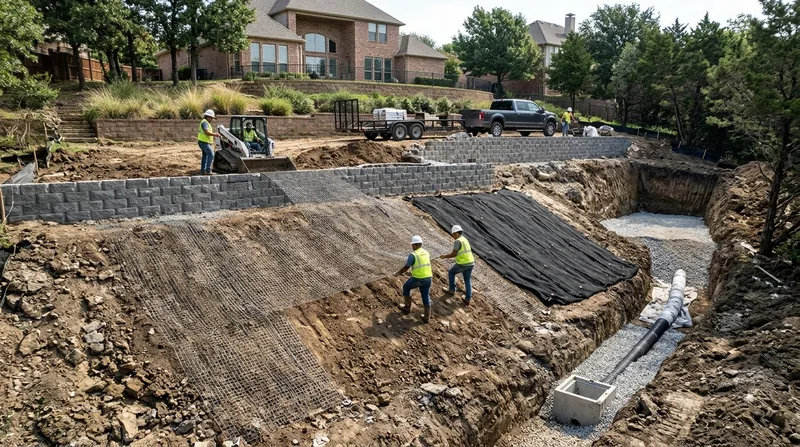




Slope stabilization and erosion control in Dallas protects your home, driveway, and yard from the relentless cycle of Blackland Prairie clay expansion and contraction. Dallas sits on clay over limestone, cut by the Trinity River and its tributaries, where creek banks collapse, bluff lots slide, and graded suburban lots shed soil with every spring downpour and summer drought. When water saturates the black clay, it swells; when heat and sun crack it, it shrinks, pulling soil and wall systems downhill. A failed or failing retaining wall on a slope is not just an eyesore, it is a safety hazard and a sign that water and soil movement are winning. We install terraced walls, geogrid reinforcement, and drainage systems to hold slopes in place, redirect water, and give your property the stability it needs to last decades, not years.
Why Slope Stabilization and Erosion Control Matters in Dallas
Dallas homeowners face a unique erosion and slope failure challenge. The combination of expansive clay soils, intense seasonal rainfall, and the bluff and creek-cut topology of neighborhoods from Oak Cliff to White Rock Lake means that slopes fail not gradually but suddenly. A wall that looks stable in August can shift or collapse after a spring rain event when the clay beneath it swells and loses bearing. Older timber and railroad tie walls, common behind 1950s and 1960s ranches across Lake Highlands and Casa Linda, fail fastest because wood rots and loses structural capacity. Newer segmental block walls on graded lots in Plano, Frisco, and McKinney fail when the base soil is not properly compacted or when water drains behind the wall instead of away from it. The cost of ignoring slope failure is high: a collapsed wall can undermine a foundation, block access to a home, or create a liability if someone is injured.
- We assess soil type, slope angle, and water flow to design a wall system that will not fail under Dallas clay expansion.
- We install geogrid reinforcement to anchor soil and distribute load over a wider base, preventing the gradual creep that precedes collapse.
- We install subsurface and perimeter drainage to move water away from the wall and reduce hydrostatic pressure on the wall face.
- We build terraced walls on steep slopes to break the fall line and reduce the total load any single wall must carry.
- We use materials rated for Dallas climate, from poured concrete to cut limestone to segmental block, each chosen for its durability and drainage performance in this specific soil and weather regime.
A properly stabilized slope protects your home, extends the life of your wall system, and eliminates the risk of sudden failure that can cost tens of thousands of dollars to repair after the fact.
Key info: In Dallas and surrounding areas like Mesquite, Richardson, and Carrollton, slopes fail most often in spring and early summer when heavy rains saturate the clay and increase water pressure behind walls. A wall that was stable all winter can suddenly lean or crack after a 4-inch rain event. Early intervention, including drainage upgrades and soil assessment, prevents catastrophic failure.
For detailed permit and engineering requirements in your jurisdiction, consult the City of Dallas Building Standards or your local building department. Many jurisdictions require engineered drawings for walls above 4 feet or when a wall supports a surcharge such as a driveway.
How We Stabilize Slopes and Control Erosion in Dallas
Our process begins with a site inspection to understand the soil, the slope, the water flow, and the reason the slope is failing or at risk. We measure the angle of the slope, identify the clay layer, look for signs of water seepage or saturation, and assess whether the existing wall (if any) is leaning, cracked, or pulling away from the soil. We then recommend a solution that may include terracing, geogrid reinforcement, subsurface drainage, and a new or rebuilt wall. We handle all permitting and coordinate with the local building department to ensure the design meets code and protects your property.
- We excavate the slope to expose the existing wall and soil, removing failed wall material and debris down to stable bearing.
- We compact and prepare the base soil, adding geotextile and gravel to improve drainage and bearing capacity before the new wall begins.
- We install the new wall in courses, backfilling with compacted soil and drainage material as we rise, ensuring no voids or soft spots that could later settle.
- We lay geogrid reinforcement horizontally in the backfill at intervals specified by the design, anchoring the soil mass and distributing load to the wall base.
- We install perimeter and subsurface drainage, including french drains, gravel beds, and perforated pipe, to capture and redirect water away from the wall and out of the slope.
- We finish the wall face, whether with cut limestone, poured concrete, or segmental block, and grade the top of the slope to shed water and prevent ponding.
The result is a slope that will not move, a wall that will not fail, and a drainage system that keeps water where it belongs, out of the soil and away from your home. We also offer retaining wall drainage services as a standalone solution if your existing wall is sound but draining poorly.
Example: A homeowner in Rowlett had a failing timber wall on a steep slope behind a 1960s ranch home. The wall was leaning outward, and the soil behind it was wet year-round. We removed the old timber wall, installed a terraced segmental block wall with geogrid reinforcement, and added a subsurface french drain. The slope is now stable, water drains away from the home, and the new wall will last 30 years or more.
| Approach | Description | Best for |
|---|---|---|
| Terraced Walls | Multiple walls stacked on the slope, each shorter than a single tall wall, reducing load and pressure on any one structure. | Steep slopes in Oak Cliff, White Rock, and creek-cut neighborhoods where a single tall wall would require deep footings and heavy reinforcement. |
| Geogrid Reinforcement | High-strength polymer mesh laid horizontally in the backfill to anchor soil and distribute lateral load over a wider area, preventing creep and settlement. | Any wall taller than 3 feet or any slope subject to heavy water infiltration, especially in expansive clay soils common across Dallas and Plano. |
| Subsurface Drainage | Perforated pipe and gravel beds installed behind the wall to capture water moving through the soil and direct it to daylight or a sump, reducing hydrostatic pressure. | Slopes where water seeps year-round or where the water table is high, common in neighborhoods near the Trinity River and along White Rock Creek. |
| Soil Regrading | Reshaping the top of the slope to eliminate flat spots and low areas where water can pond, and to direct surface runoff away from the wall and toward storm drains. | Any slope where water is not naturally shedding, including graded lots in newer subdivisions in Frisco, McKinney, and Carrollton where fill was not properly compacted. |
Slope Stabilization and Erosion Control Cost in Dallas: What to Expect
The cost of slope stabilization and erosion control in Dallas depends on the slope area, the height and type of wall, the condition of the existing wall (if any), soil type, and drainage requirements. A small terraced wall with minimal drainage on a stable soil may cost less than a tall, reinforced wall on expansive clay with a high water table. We always start with a free estimate and a site visit so we can measure the slope, test the soil, and understand the water flow before we quote a price. Most slope stabilization projects in Dallas range from a few thousand dollars for a small repair to fifteen or twenty thousand dollars for a full terraced system with geogrid and drainage on a large or steep slope.
Factors that move the cost up include slope height, wall length, geogrid reinforcement requirements, subsurface drainage complexity, soil conditions, and site access. If the slope is steep, the soil is clay, and water is actively seeping, you will need more reinforcement and drainage, which increases cost. If the existing wall must be demolished and hauled away, that adds labor and disposal fees. We recommend getting 2 or 3 estimates from licensed contractors so you can compare approach, materials, and price. Visit our pricing page for more detail on how we structure estimates and what drives cost in different scenarios.
What to Look for When Hiring a Slope Stabilization Contractor Near Me in Dallas
Ask for photos of completed work, especially any terraced or geogrid-reinforced walls, so you can see the quality of the finish and the durability of the materials. Check whether the contractor has experience with Dallas clay soils and understands the specific failure modes that dominate in this region, such as spring swelling and summer shrinkage cracks.
Ask the contractor to explain the permitting process and whether engineered drawings are required for your wall. Many jurisdictions in the Dallas area require a permit for walls above 4 feet or when a wall supports a surcharge such as a driveway or structure. If you live in a neighborhood with an HOA, verify that the new wall design complies with CC&Rs and setback requirements before work begins. Get at least 2 estimates in writing, including the scope of work, materials, timeline, and warranty. Call Dallas Retaining Wall at (469) 436-3386 for a free estimate and to discuss your specific slope and soil conditions. We serve Dallas, Plano, Garland, Irving, Mesquite, Richardson, Carrollton, Rowlett, Rockwall, McKinney, Allen, Frisco, DeSoto, Cedar Hill, Wylie, and Forney, and we are licensed and insured for all slope stabilization and retaining wall repair work in North Texas.
Slope Stabilization & Erosion Control in Dallas: Pricing Guide
| Service | Price | Details |
|---|---|---|
| Free Estimate | No charge | Site visit, soil and slope assessment, photo documentation, and written estimate within 24 hours, no obligation to book |
| Small Terraced Wall with Drainage | Starting at $4,500 | Slopes under 200 sq ft, single or double wall tier, geogrid, subsurface drain, material and labor included |
| Medium Slope Stabilization System | Starting at $10,000 | Slopes 200 to 500 sq ft, multiple wall tiers, geogrid reinforcement, french drain, perimeter drainage, compaction and finishing |
| Large or Complex Slope Project | On estimate | Slopes over 500 sq ft, steep angles, high water table, poor soil, or engineered design required; price determined after site assessment and soil testing |
| Travel | Included | No separate mileage or call-out fee within Dallas and surrounding areas; travel time absorbed in estimate |
| Warranty | 1 year | All workmanship and materials covered for one year from completion date; drainage performance guaranteed |
Indicative pricing, the exact cost depends on square footage, finish, and site access. Free personalized estimate within 24h at (469) 436-3386.


