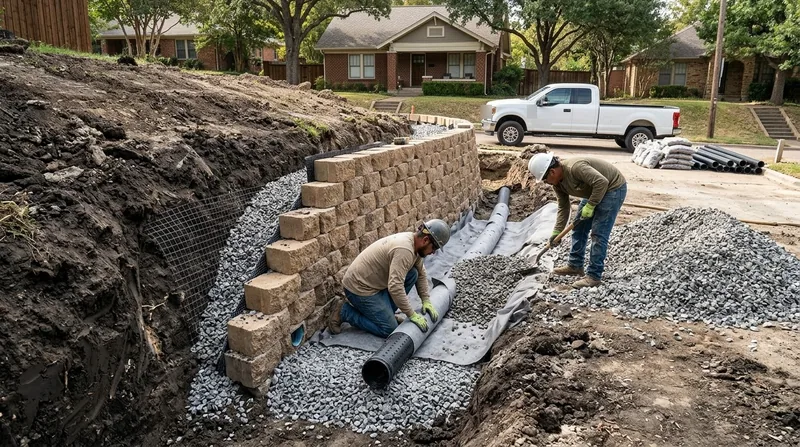




Retaining Wall Drainage in Dallas is not optional, it is the difference between a wall that lasts 20 years and one that fails in five. Dallas sits on Blackland Prairie clay that swells with spring rains and shrinks under summer heat, creating relentless hydrostatic pressure against every retaining wall on the landscape. Whether your wall is poured concrete along a Trinity River bluff, segmental block stepped into a Plano suburban lot, or aging timber behind a Lake Highlands ranch, water trapped behind it will push, crack, and topple it. Our drainage systems remove that pressure before it destroys your wall, your yard, and your wallet. We install French drains, weep holes, gravel backfill, and waterproofing that work together to move water away from the soil mass and out of the equation. Call us at (469) 436-3386 for a free estimate, or learn more about retaining wall repair if your wall is already showing signs of failure.
Why Retaining Wall Drainage Fails in Dallas: The Hydrostatic Pressure Problem
Dallas clay does not drain. When spring thunderstorms dump two or three inches of rain on a sloped yard, that water has nowhere to go. It soaks into the soil behind your wall, adding weight and pressure that pushes outward with tremendous force. Over months and years, that pressure cracks the wall, separates it from its footing, and causes it to lean, bow, or collapse entirely. Hydrostatic pressure is the number one cause of retaining wall failure in North Texas, far outpacing poor construction or weak materials. A wall without proper drainage is a wall on borrowed time.
- Water-saturated clay behind an undrained wall can exert pressure equivalent to thousands of pounds per linear foot.
- Even a small crack in the wall allows water to penetrate deeper, freezing in winter and expanding to widen the damage.
- A leaning wall is a sign that drainage has already failed and the wall is beginning to yield to pressure.
- Proper drainage installed at the time of construction costs a fraction of repair or replacement later.
These failures are predictable and preventable. The walls that stand longest in Dallas are those with deliberate drainage systems built in from the start.
Key info: A segmental block wall in Richardson or a poured concrete wall in Garland that shows water seeping from the base, or dark staining along the face, has already lost its drainage capacity. That wall needs immediate attention before it fails.
For more on walls that are already failing, see our leaning and collapsed wall repair service.
How We Install Retaining Wall Drainage in Dallas: Step by Step
Our approach to drainage is systematic and built on the principle that water must be intercepted, collected, and moved away from the wall. We assess the soil type, the slope of the yard, and the wall height to design a drainage strategy that fits the site. On Dallas clay, this almost always means a combination of methods working together, not a single quick fix. We do not skimp on the gravel backfill or the depth of the drain line, because shortcuts fail when the next heavy rain comes.
- We excavate behind the wall to expose the footing and assess existing drainage or damage.
- We install a perforated drain pipe at the base of the wall, sloped to daylight or to a sump.
- We backfill with clean, free-draining gravel (never clay or topsoil) to allow water to flow toward the drain pipe.
- We install geotextile fabric to prevent fine soil particles from clogging the gravel and drain pipe over time.
- We add weep holes through the wall face at regular intervals to allow water to exit if it accumulates behind the wall.
- For walls supporting a surcharge such as a driveway, we add a waterproofing membrane to the wall face to reduce water infiltration.
The result is a wall that sheds water instead of absorbing it, and a yard that stays dry even after a Dallas thunderstorm.
Example: A homeowner in Oak Cliff had a 6-foot timber wall that was leaning badly after three years of heavy rains. We removed the failed timber, installed a new segmental block wall with a full drainage system, French drain to daylight, and weep holes every 4 feet. The wall has remained plumb and dry for five years since.
Learn more about our retaining wall installation process to see how drainage is integrated from day one.
Retaining Wall Drainage Methods and Materials
| Method | How It Works | Best For |
|---|---|---|
| French Drain | Perforated pipe buried in gravel at the wall base, sloped to daylight or sump pump, intercepts and removes groundwater. | Most Dallas walls, especially those on sloped lots or in areas with poor surface drainage. |
| Weep Holes | Small openings through the wall face, typically 4 inches in diameter, allow water to exit if it pools behind the wall. | All retaining walls, used in combination with French drains for redundant drainage paths. |
| Gravel Backfill | Clean, free-draining stone (typically 3/4-inch minus) replaces clay behind the wall, allowing water to flow downward and out. | Every Dallas retaining wall, critical for allowing water movement and reducing hydrostatic pressure. |
| Waterproofing Membrane | Applied to the wall face, reduces water infiltration into the wall structure itself, especially important for concrete and masonry. | Walls supporting a surcharge (driveway, patio, structure) or walls built in areas prone to standing water. |
| Sump Pump System | Collects water in a basin at the wall base and pumps it away when water level rises, for sites where daylight drainage is not possible. | Walls in low-lying areas, yards without slope, or properties where gravity drainage cannot reach a natural outlet. |
Each method addresses a different aspect of the drainage problem. We combine them based on your site, soil, and wall type to create a system that works in Dallas heat and rain.
Retaining Wall Drainage Cost in Dallas: What to Expect
Drainage work on an existing wall typically starts at $2,500 for a straightforward French drain installation on a smaller wall, but the final cost depends on several factors. The length of the wall, the depth of the drain line, whether you need a sump pump, the accessibility of the site, and whether we are excavating through established landscaping all affect the price. A wall 30 feet long with a full French drain system, geotextile, gravel backfill, and weep holes will cost more than a shorter wall with the same system. A wall in a tight corner of a Plano backyard costs more to access than one on an open slope.
The best way to understand your cost is to get two or three estimates from licensed contractors. We provide free estimates within 24 hours and will walk you through what is included at each price level. We also recommend reviewing the full pricing overview to see how our rates compare across different wall types and drainage scenarios.
Keep in mind that investing in proper drainage now costs far less than replacing a failed wall or repairing foundation damage caused by water infiltration. A wall that lasts 25 years is cheaper per year than one that fails in five.
Retaining Wall Drainage Near Me: What Dallas Homeowners Should Know Before Hiring
When you are ready to hire a contractor for retaining wall drainage, start with the basics. Verify that the contractor is licensed and insured in Texas, and ask to see proof of insurance covering both general liability and workers compensation. Check references from recent projects in your area, Dallas, Plano, Garland, or Richardson. Ask how many similar drainage projects they have completed on clay soil, and what their approach is to preventing future failure. Do not hire based on price alone, because a cheap job done wrong will fail, and you will pay twice.
Understand also that permit requirements vary by city. Some Dallas jurisdictions require a permit for any wall work, others only for walls above 4 feet or walls supporting a surcharge. Contact your local building department or ask your contractor to verify the rules for your property. Some older neighborhoods in Oak Cliff, Lakewood, or Kessler Park may have HOA rules or deed restrictions that apply to wall work. Knowing these upfront prevents costly delays.
Finally, get everything in writing. The estimate should list the drainage methods, materials, depth of excavation, slope of the drain line, and timeline. It should also clarify what is and is not included, such as disposal of excavated soil or restoration of landscaping. Contact us for a free estimate and a detailed scope of work for your project.
Retaining Wall Drainage in Dallas: Pricing Guide
| Service | Price | Details |
|---|---|---|
| French Drain Installation (per linear foot) | Starting at $85 to $150 | Includes perforated pipe, gravel backfill, geotextile, and labor for a standard 2 to 3-foot deep drain at wall base |
| Complete Drainage System (smaller wall) | Starting at $2,500 | French drain, weep holes, gravel backfill, and geotextile for a wall 20 to 30 feet long and up to 4 feet tall |
| Drainage Retrofit with Excavation (existing wall) | Starting at $3,500 | Includes excavation behind wall, French drain installation, backfill, and weep holes for walls requiring access and soil removal |
| Sump Pump System Addition | Starting at $1,200 | Basin, pump, electrical hookup, and discharge line for sites where gravity drainage to daylight is not feasible or possible |
| Waterproofing Membrane Application | Starting at $500 | Protective coating applied to wall face to reduce water infiltration, typically used on walls supporting driveways or structures |
| Free Estimate | No charge | Response within 24 hours at (469) 436-3386, includes site assessment and written scope of work with no obligation |
Indicative pricing, the exact cost depends on square footage, finish, and site access. Free personalized estimate within 24h at (469) 436-3386.


