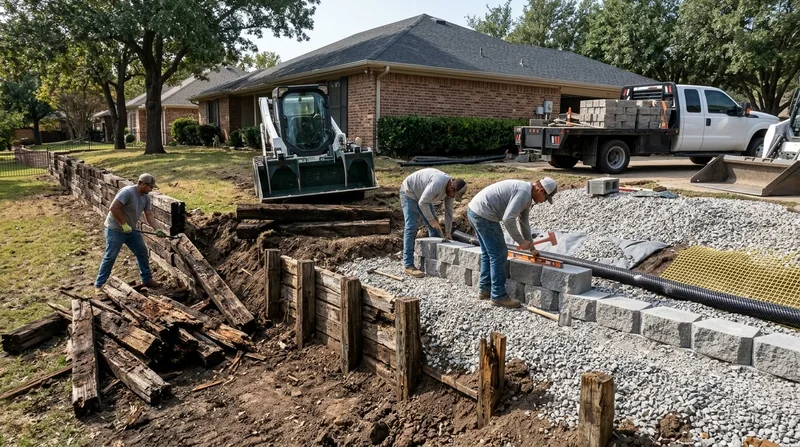




Railroad Tie Wall Replacement in Dallas is one of the most common retaining wall jobs we handle, especially across the postwar ranch neighborhoods and older established areas where these walls were built in the 1980s and 90s. The Blackland Prairie clay beneath Dallas swells in spring downpours and shrinks hard in summer drought, cracking creosote-treated ties and pushing them out of plumb. You'll see failing railroad tie walls behind ranches in Lake Highlands, Casa Linda, and the neighborhoods near White Rock Creek ravines, where drainage problems and soil movement have left them leaning, cracked, or partially collapsed. We remove the old ties, haul away the debris, rebuild your slope with proper drainage and backfill, and install a new wall in segmental block, poured concrete, or Texas limestone that will handle the clay movement for decades. This page walks you through why these walls fail, how we replace them, what it costs, and what to look for when hiring a contractor near you.
Why Railroad Tie Walls Fail in Dallas: Clay, Drainage, and Time
Railroad ties were an affordable, quick solution for backyard slope control in the 1980s and 90s, but they were never engineered for Dallas clay. The black clay here expands when wet and contracts when dry, exerting lateral pressure that ties cannot resist. Creosote treatment slows rot but does not stop it, especially when drainage is poor and water sits against the back of the wall. After 30 to 40 years, ties crack, split, and lean; the gravel behind them washes away; and the wall either tilts or fails altogether.
- We identify signs of failure: visible lean, horizontal cracks in ties, water pooling or seeping at the base, or ties that have rotted through.
- We evaluate drainage behind the wall to confirm whether water management or soil pressure is the primary driver of failure.
- We assess whether the wall is supporting a surcharge such as a driveway, deck, or shed, which requires engineered replacement.
- We confirm setback and property-line rules with your local building department before we draft a plan.
Understanding why your wall failed helps us choose the right replacement material and drainage strategy for your Dallas lot.
Key info: A leaning or collapsed railroad tie wall in Dallas is almost always a clay and drainage problem. Ties cannot resist the seasonal swelling of Blackland Prairie clay. Segmental block, concrete, or limestone replacement walls are engineered to handle this movement and last 50+ years with proper backfill and drainage.
For more on identifying wall failure, see our guide to Leaning and Collapsed Wall Repair in Dallas.
How We Replace Your Railroad Tie Wall: Step-by-Step Process
Replacement is not a patch job. We demolish the old wall completely, clear the debris and rotted ties, prepare the base, install new drainage, and build a new wall from the ground up. The job takes 3 to 7 days depending on wall length and height, and the result is a wall that will not fail again under Dallas clay and weather.
- We remove all old railroad ties, posts, and failed materials by hand and machine, then haul them away.
- We excavate the footing area and verify compaction and bearing capacity on the native clay or limestone.
- We install a gravel base and perforated drainage pipe at the back of the footing to manage subsurface water.
- We backfill behind the wall with clean gravel (not clay) to allow water to drain and reduce lateral pressure.
- We build the new wall in your choice of material: segmental block, poured concrete, or stacked Texas limestone.
- We grade and seed the slope above the wall and confirm drainage flows away from the structure.
Every replacement wall we build is designed to shed water, resist clay pressure, and last as long as your home.
Example: A 4-foot railroad tie wall in Lakewood that was leaning 8 inches required full removal, new footing, perforated drain pipe, and a rebuilt segmental block wall. Total time: 5 days. Cost: $4,200. The homeowner now has a wall that matches the neighborhood aesthetic and will not move.
See our full Retaining Wall Replacement in Dallas service page for more on scope and timeline.
Replacement Methods: Segmental Block, Concrete, and Texas Limestone
Once the old ties are gone, you have three proven options. Each has a different cost, aesthetic, and performance profile. Your choice depends on your budget, the wall height, and whether you want a modern or traditional look.
| Approach | Description | Best for |
|---|---|---|
| Segmental Block (SRW) | Interlocking concrete blocks with a geogrid reinforcement. Fast to install, uniform appearance, and engineered for tall or tiered walls. | Suburban lots, tall walls (4 to 8 feet), homeowners who want a clean, modern look and long-term durability. |
| Poured Concrete | Monolithic concrete wall, often with a stone or stucco finish. Strongest option, lowest maintenance, can be textured or colored. | High-load applications (driveways, structures), areas with severe clay pressure, and homeowners who prioritize strength and longevity. |
| Texas Limestone (Stacked) | Dry-stacked or mortared native limestone. Aesthetic match to older Dallas homes, natural appearance, and locally sourced material. | Historic neighborhoods (Lakewood, Oak Cliff, Kessler Park), shorter walls (3 to 5 feet), and homeowners who want traditional character. |
| Timber or Composite (New) | Pressure-treated lumber or composite boards. Not a repeat of old railroad ties, but engineered timber walls with proper engineering and drainage. | Homeowners who want a warm, natural look and are willing to invest in proper engineering and maintenance to avoid the old tie failures. |
We recommend segmental block for most Dallas replacements because it is fast, engineered, and handles clay movement well. For historic homes or traditional aesthetics, stacked limestone is unbeatable. Poured concrete is the strongest choice if your wall supports a heavy load.
Railroad Tie Wall Replacement Cost in Dallas: What to Expect
Railroad tie wall replacement in Dallas starts at around $35 per square foot for a segmental block wall of moderate height on a lot with good access. A 4-foot-tall wall that is 30 feet long (120 square feet) typically runs $4,200 to $5,400, including demolition, new footing, drainage, and the new wall itself. Cost moves up if the wall is taller, longer, or if your lot has poor access or difficult soil conditions that require extra excavation or engineering.
Poured concrete replacement walls run higher, typically $45 to $60 per square foot, because of formwork and labor. Texas limestone stacked walls run $40 to $55 per square foot depending on stone availability and whether you choose dry-stacked or mortared. The best way to know your exact cost is to get a free, no-obligation estimate from us. We'll visit your property, measure the wall, assess the soil and drainage, and give you a firm quote within 24 hours.
Factors that affect cost include wall height (taller walls need deeper footings and more material), wall length, soil conditions (clay that is hard or saturated costs more to excavate), access to the site (narrow gates or steep grades slow us down), and whether the wall is supporting a surcharge such as a driveway or deck (which may require engineered drawings and cost more). We always recommend getting 2 to 3 estimates so you can compare scope and price.
See our full pricing overview for material-by-material breakdowns and what is included in each estimate.
Railroad Tie Wall Replacement Near Me: What Dallas Homeowners Should Know When Hiring
Not all contractors understand Dallas clay or the drainage demands of retaining walls. Before you hire, verify that the contractor is licensed and insured, check references from recent jobs in your neighborhood, and ask whether they pull permits and work with your local building department. Many walls above 4 feet or walls that support a structure require a permit and possibly engineered drawings. Your contractor should handle this, not leave it to you.
- Ask for references from at least three railroad tie wall replacements completed in Dallas within the last two years.
- Verify that the contractor understands permit requirements for your city (Dallas, Plano, Garland, Irving, Mesquite, or elsewhere in the DFW area).
- Get a written estimate that breaks down demolition, footing, drainage, backfill, and the new wall material as separate line items.
- Ask whether the wall is engineered for your lot and whether the contractor will provide a copy of the design or calculations.
- Confirm the timeline and whether the contractor has a crew available to start within your needed window.
A good contractor will answer all of these questions without hesitation and will explain how the new wall will handle Dallas clay and weather. Call us at (469) 436-3386 or visit our contact page to schedule a site visit.
Railroad Tie Wall Replacement in Dallas: Pricing Guide
| Service | Price | Details |
|---|---|---|
| Segmental block wall replacement | Starting at $35/sq ft | Demolition, footing, drainage pipe, gravel backfill, and interlocking block wall. Height and access are the main cost drivers. |
| Poured concrete wall replacement | Starting at $45/sq ft | Demolition, footing, drainage, formwork, concrete pour, and finish. Higher cost reflects labor and material for monolithic strength. |
| Texas limestone stacked wall replacement | Starting at $40/sq ft | Demolition, footing, drainage, and dry-stacked or mortared native limestone. Material sourcing and stone placement add to labor time. |
| Tall or engineered wall replacement | On estimate | Walls above 6 feet or supporting a driveway or structure require engineered drawings and site-specific calculations. Schedule a free site visit. |
| Travel and mobilization | Included | No separate charge for travel within Dallas and surrounding service areas. We arrive ready to work and haul debris away same day. |
| Free estimate | No charge | Response within 24 hours at (469) 436-3386. We measure, assess soil and drainage, and provide a firm written quote with no obligation to book. |
Indicative pricing, the exact cost depends on square footage, finish, and site access. Free personalized estimate within 24h at (469) 436-3386.


