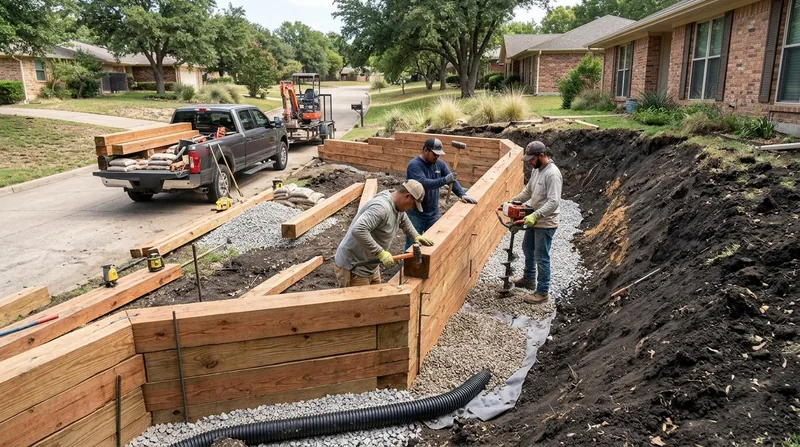




Timber retaining walls in Dallas offer a budget-friendly way to terrace sloped lots, define garden beds, and manage erosion on properties across the city. From the oak-lined lots of Oak Cliff and Lakewood to the postwar ranches of Lake Highlands and the newer subdivisions of Plano and Frisco, timber walls have been a standard solution for decades. However, Dallas's unforgiving climate, dominated by Blackland Prairie clay that swells in spring downpours and shrinks under summer heat, puts real pressure on wood structures. If your timber wall is leaning, rotting, or failing, or if you're planning a new installation, understanding when timber makes sense and when a longer-lasting material is the better choice will save you money and frustration. We install, repair, and replace pressure-treated timber retaining walls across Dallas and the surrounding communities, and we're honest about both their strengths and their limits. Learn more about our full retaining wall installation services to explore all your options.
Why Timber Retaining Walls Matter in Dallas: Climate and Soil Reality
Dallas sits on Blackland Prairie clay over Austin Chalk limestone, a combination that creates serious challenges for any retaining structure. The clay expands dramatically when saturated by spring rains and contracts sharply during the intense, dry summers, putting constant stress on timber and fasteners. Timber walls fail in Dallas not because the wood itself is poor quality, but because the soil beneath and behind them moves relentlessly. A pressure-treated timber wall can last 15 to 20 years with proper drainage and maintenance, but that timeframe assumes good installation and consistent upkeep. Many older timber walls across Dallas, installed in the 1980s and 1990s behind ranches in Lake Highlands, Casa Linda, and Wylie, are now reaching the end of their service life. Understanding this reality helps you make a smart choice about repair versus replacement.
- Timber walls absorb water and deteriorate faster in clay-heavy soil that retains moisture year-round.
- Freeze-thaw cycles in North Texas winters can split wood and loosen bolts, especially in walls over 4 feet tall.
- Termite and carpenter ant damage is common in Dallas timber walls, particularly in shaded, humid microclimates.
- Proper drainage behind a timber wall is essential, yet many older installations lack it entirely.
These factors explain why so many Dallas homeowners face timber wall failure and why professional assessment is the first step to a lasting fix.
Key info: Dallas Building Department requires a permit for retaining walls over approximately 4 feet in height measured from the footing, or when a wall supports a surcharge such as a driveway or structure. Engineered drawings may be required for tall or tiered walls. Always verify current setback and property-line rules with your local jurisdiction before design or installation.
For more on the structural challenges that lead to wall failure, see our guide to leaning and collapsed wall repair.
How We Install and Repair Timber Retaining Walls in Dallas: Step-by-Step Process
Our approach to timber wall work in Dallas starts with a site inspection to assess soil conditions, drainage, and the wall's current state. We measure the slope, check for settling or rot, and confirm whether repair or replacement is the right call. For new installations, we set a proper footing below the frost line, compact the base, and install drainage behind the wall to manage the heavy spring runoff that defines the Dallas season. Every timber wall we build includes pressure-treated lumber rated for ground contact, galvanized fasteners to resist corrosion, and clear guidance on maintenance intervals. For repairs, we may reinforce the existing wall, replace rotted sections, or recommend full replacement if the structure has lost integrity.
- We excavate and inspect the footing to confirm it sits below the local frost depth and is not undermined by soil movement.
- We install a compacted gravel base and perforated drain line to channel water away from the wall and reduce hydrostatic pressure.
- We set pressure-treated posts or timbers using galvanized bolts and hardware, ensuring proper spacing and alignment.
- We backfill with gravel on the drain side and compacted soil on the face side, with clear instructions for long-term maintenance.
- We verify the wall is level and plumb, and we confirm that any required permits have been obtained and inspected.
This systematic approach has prevented callback issues and early failures across Dallas neighborhoods from Lakewood to Richardson.
Local example: A homeowner in Oak Cliff had a 3-foot timber wall behind a 1920s Tudor that was leaning outward and showing rot at the base. We removed the old wall, installed proper drainage, and rebuilt it with pressure-treated 6x6 posts set in concrete footings. The new wall has remained stable for over five years and required no repairs. The key difference was the footing depth and the drainage line we installed to manage the heavy clay soil.
Learn more about retaining wall drainage solutions that protect timber and all other wall types in Dallas's wet season.
Timber Retaining Wall Installation Methods: A Comparison
| Approach | Description | Best for |
|---|---|---|
| Pressure-treated timber posts and beams | Standard 4x4, 4x6, or 6x6 posts set in concrete footings, bolted together with galvanized hardware and backfilled with gravel and soil. | Garden terraces, low to medium slopes, budget-conscious homeowners in Dallas suburbs like Plano and Garland. |
| Timber wall with reinforcing pins or soil anchors | Posts or timbers reinforced with steel pins driven through the wall into the soil, or with soil anchors extending back into the slope to resist outward pressure. | Taller walls (4 to 6 feet), steeper slopes, or sites where the wall must resist significant hydrostatic load from Dallas clay soil. |
| Composite or recycled-plastic timber (alternative) | Engineered lumber made from recycled plastic and wood fiber, resistant to rot and termites, installed similarly to pressure-treated timber. | Homeowners seeking longer life (25+ years) and minimal maintenance, even though initial cost is higher than pressure-treated wood. |
| Railroad tie wall replacement or upgrade | Removal of deteriorated old railroad ties and replacement with new pressure-treated timbers or segmental block, often including improved drainage and footing. | Older Dallas ranches and Lake Highlands properties where the original tie wall has failed, or where homeowners want a more modern and durable wall. |
Timber Retaining Walls Cost in Dallas: What to Expect
Timber retaining wall costs in Dallas typically start at $20 per square foot for a straightforward installation on a level or gently sloped site with good access and stable soil. That baseline assumes pressure-treated lumber, standard hardware, and basic gravel backfill. However, several factors can push the price higher. If your site has poor access, heavy clay that requires extra excavation, or a slope steeper than 2:1, costs can climb to $30 to $40 per square foot or more. Walls over 4 feet tall that require engineered drawings and multiple tiers add complexity and cost. A 20-foot-long wall standing 4 feet high might run $1,600 to $3,200 depending on these variables. Getting 2 or 3 estimates from licensed contractors in Dallas is smart practice, because site-specific conditions often surprise first-time budgeters.
For a detailed breakdown of pricing across all wall types and conditions, visit our full pricing overview. Repair costs vary widely, from $500 to $2,000 for targeted timber replacement or bolt reinforcement, to $3,000 to $6,000 or more for partial or full wall reconstruction. The key driver is whether the failure is localized (a few rotted boards or loose bolts) or structural (the footing has settled, the entire wall is leaning). We provide free estimates so you know exactly what you're paying for before any work begins.
Timber Retaining Walls Near Me: What Dallas Homeowners Should Know Before Hiring
Choosing the right contractor for timber wall work in Dallas requires more than just picking the lowest bid. First, confirm that your contractor is licensed and insured for retaining wall work in Texas. Second, get multiple estimates and ask each contractor to walk you through their approach to footing depth, drainage, and fastening. Third, check references from recent jobs in your neighborhood. Homeowners in Lakewood, Oak Cliff, or Mesquite can often point you toward contractors who understand the specific soil and climate challenges of their area. Fourth, if your wall is over 4 feet or if it supports a structure or driveway, confirm that the contractor will pull a permit and work with your local building department. Many Dallas municipalities, including the City of Dallas itself, require inspections for walls above this threshold. Fifth, if your property is in an HOA community, check your covenants before design to avoid costly rework.
- Ask your contractor for references from at least three jobs completed in the past 18 months in your city or nearby.
- Request a written estimate that specifies lumber grade, fastener type, drainage details, and any site-specific conditions that affect price.
- Confirm that your contractor has obtained any required permits and that inspections will be scheduled at key stages.
- Discuss maintenance expectations, including drain line cleaning, bolt checks, and when to expect the wall to need repair or replacement.
- Verify that your contractor carries liability insurance and can provide a certificate of insurance if requested.
Taking these steps protects your investment and ensures the wall you build will perform well in Dallas's demanding climate. Contact us for a free, no-obligation estimate and to discuss your site conditions and goals.
Timber Retaining Walls in Dallas: Pricing Guide
| Service | Price | Details |
|---|---|---|
| Standard pressure-treated timber wall | Starting at $20/sq ft | Pressure-treated posts, galvanized fasteners, gravel backfill, and basic drainage on accessible level or gently sloped sites |
| Reinforced timber wall with soil anchors | Starting at $30/sq ft | Posts with steel reinforcing pins or soil anchors for taller walls or steep slopes in Dallas clay soil requiring extra stability |
| Timber wall repair or partial replacement | $500 to $3,000 | Targeted rot repair, bolt reinforcement, or section replacement depending on whether failure is localized or structural |
| Full timber wall replacement or engineered design | On estimate | Removal of failed wall, new footing, engineered drawings if required by permit, and complete installation with upgraded drainage |
| Travel and site visit | Included | No separate mileage or travel fee within Dallas and surrounding service area communities |
Indicative pricing, the exact cost depends on square footage, finish, and site access. Free personalized estimate within 24h at (469) 436-3386.


