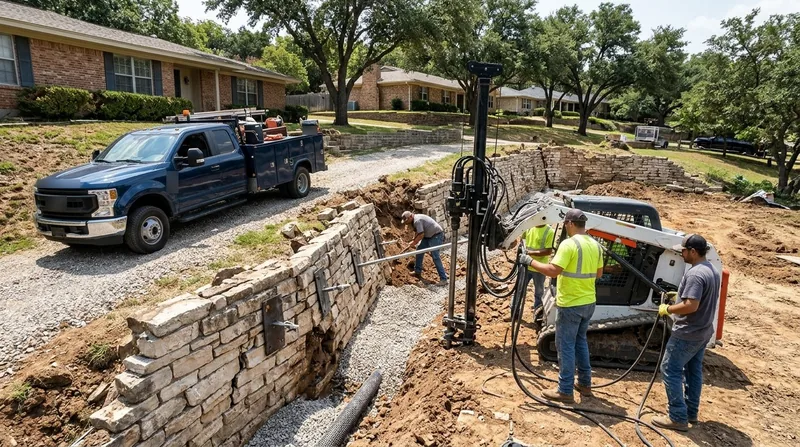




Dallas retaining walls face a relentless enemy: the Blackland Prairie clay beneath your home. This soil swells violently in spring and early summer downpours, then shrinks and cracks under the hard, bright sun of drought. Over time, that cyclical movement pushes walls out of plumb, cracks them, and eventually collapses them. Retaining Wall Repair in Dallas stops that damage before your wall fails completely, protecting your yard, driveway, and foundation. Whether your wall is leaning, bowing, settling, or already showing deep cracks, we diagnose the root cause and repair it. Call us at (469) 436-3386 for a free estimate, or learn more about our full retaining wall installation and design services.
Why Retaining Wall Repair Matters in Dallas: Clay, Drainage, and Failure Before Collapse
Dallas walls fail because the clay moves. A wall that leans 2 inches today will lean 6 inches next year, and by year three it may be unsafe. The cost of repairing a leaning wall now is a fraction of what you'll pay to rebuild it after collapse, or to fix the damage it does to adjacent structures. Water is the accelerant. Most Dallas walls lack proper drainage, so spring rains saturate the soil behind the wall, adding weight and pressure that no gravity alone can hold. We catch these failures early by inspecting for the telltale signs: horizontal cracks, stepped cracks in block, soil bulging behind the wall, or the wall tilting visibly away from vertical.
- We assess the wall's tilt, crack pattern, and soil movement to determine whether repair is possible or replacement is necessary.
- We install or improve drainage systems to remove water pressure and stop the clay from expanding against the wall.
- We install tieback anchors, soil nails, or shear keys to anchor the wall and resist lateral clay pressure.
- We rebuild sections of the wall if the damage is localized, or we stabilize and reinforce the entire structure if needed.
- We verify that the repair meets local code and that your wall is safe for another decade or more.
Early repair prevents catastrophic failure and protects your property investment in Dallas neighborhoods from Oak Cliff to Lake Highlands.
Key info: Dallas and surrounding cities (Plano, Garland, Irving, Mesquite, Richardson) sit on the same Blackland Prairie clay. Walls here fail fastest in spring and early summer when the clay is most active. If your wall is leaning or cracking, do not wait until fall or winter to call. The damage accelerates during wet months.
For more details on how clay movement and water damage your walls, see our page on retaining wall drainage solutions.
For regulatory guidance, homeowners in Dallas should consult the City of Dallas Building Services to confirm permit requirements for walls above 4 feet or walls that support a surcharge such as a driveway or structure.
How We Repair Retaining Walls in Dallas: Diagnosis, Drainage, and Stabilization
Our repair process begins with a thorough site inspection. We measure the wall's tilt, probe the soil behind it, observe the crack pattern, and test drainage. We identify whether the failure is caused by poor drainage, soil movement, inadequate design, or a combination. Once we understand the failure mode, we design a repair strategy that addresses the root cause, not just the symptom. Small repairs take a few days; larger stabilization projects may take one to two weeks depending on wall length and soil conditions.
- We excavate carefully around the wall to expose the footing and assess soil conditions without destabilizing the structure further.
- We install or repair drainage pipe, gravel, and geotextile to channel water away from the wall and reduce soil pressure.
- We install anchors, tiebacks, or shear keys into stable soil or bedrock to resist the lateral force pushing the wall outward.
- We rebuild or reinforce the wall face if cracks are deep, if mortar is failing, or if the wall is bowing visibly.
- We compact and finish the repair, test drainage function, and verify that the wall is plumb and stable before we leave the site.
This methodical approach ensures that your wall repair is permanent and safe, not a temporary patch that fails again in two years.
Example: A homeowner in Lakewood noticed her 1920s limestone retaining wall leaning outward by 3 inches. Water was pooling behind it and seeping into the basement of her Tudor. We excavated the wall, installed a perforated drain pipe at the footing, backfilled with gravel and geotextile, and installed two tieback anchors into the limestone bedrock. The wall returned to plumb, the basement stayed dry, and the wall has been stable for four years.
Learn more about our leaning and collapsed wall repair services and our approach to slope stabilization.
Retaining Wall Repair Methods: Choosing the Right Fix for Your Wall
| Approach | Description | Best for |
|---|---|---|
| Drainage Repair | Install or repair perforated drain pipe, gravel backfill, and geotextile to remove water pressure behind the wall. | Walls that are leaning slowly or showing minor cracks caused by water saturation. |
| Tieback Anchors | Install steel rods deep into stable soil or bedrock behind the wall to pull it back toward vertical and resist outward pressure. | Walls leaning 2 to 4 inches or showing horizontal cracks in the upper third of the wall. |
| Soil Nails | Drive or drill steel nails horizontally into the soil behind the wall and connect them to a facing board or grid to reinforce the soil mass. | Walls with stable soil behind them but weak or deteriorating wall face, or walls showing stepped cracks in block. |
| Shear Keys and Footing Reinforcement | Install concrete or steel keys at the footing to increase the wall's resistance to sliding and prevent the base from moving outward. | Walls settling or sliding at the base, or walls on clay soil with weak footing conditions. |
| Partial or Full Rebuild | Remove and reconstruct sections of the wall or the entire wall, using the original material or upgrading to a more durable system. | Walls with extensive cracking, failing mortar, or severe bowing that cannot be stabilized in place. |
The right repair method depends on the wall's material, age, failure mode, and the stability of the soil around it. We assess all these factors during our inspection and recommend the most cost-effective and durable solution.
Retaining Wall Repair Cost in Dallas: What to Expect
Retaining wall repair costs in Dallas start at $1,500 for small drainage improvements or minor crack repairs on walls under 4 feet tall. A mid-size repair involving drainage installation and one or two tieback anchors on a wall 4 to 8 feet tall typically ranges from $3,500 to $7,000. Larger repairs, full stabilization projects, or partial rebuilds can range from $8,000 to $20,000 or more, depending on the wall's length, height, material, and soil conditions. Emergency stabilization of a severely leaning or partially collapsed wall may cost more due to the urgency and specialized equipment needed.
The main factors that move the cost are the wall's height and length, the extent of drainage work required, the number and depth of anchors needed, whether the wall face needs rebuilding, and site access. A wall in a tight backyard with limited equipment access costs more than an open lot. A wall on difficult soil (like Dallas clay with embedded limestone) may require deeper anchors or specialized drilling. We always provide a written estimate after the site inspection, and we encourage homeowners to get two or three estimates before deciding. See our full pricing page for more detail on service-specific costs and what is included at each price point.
Most repairs can be completed within one to two weeks, though complex projects may take longer. We work efficiently to minimize disruption to your yard and home.
Retaining Wall Repair Near Me: What Dallas Homeowners Should Know When Hiring a Contractor
When you're looking for a retaining wall contractor near Dallas, Plano, Garland, or any of the surrounding areas, start by verifying that the company is licensed and insured. Get at least two or three estimates in writing, and compare not just the price but the scope of work, materials, and timeline. Check references from past repair jobs in your neighborhood. Ask whether the contractor has handled clay-soil failures or drainage repairs before, because not all contractors understand the specific challenges of Dallas retaining walls.
- Verify that the contractor is licensed, bonded, and insured before you sign a contract or pay a deposit.
- Confirm whether your wall repair requires a permit from your city or county, and whether the contractor will handle permitting or if you must apply yourself.
- Ask the contractor to explain the failure mode and why their proposed repair addresses it, not just the symptom.
- Request a written warranty on materials and labor, typically one to two years for drainage and anchor work.
- Check whether your HOA has rules about wall repairs or material choices, and confirm that the contractor's plan complies with those rules.
A good contractor will answer your questions clearly, provide references, and give you a detailed estimate that breaks down the cost by task. Do not choose a contractor based on price alone. The cheapest estimate often means the contractor is cutting corners or underestimating the scope.
Contact us today for a free, no-obligation estimate. We'll inspect your wall, explain what we find, and give you a clear price and timeline. Call (469) 436-3386 or fill out our contact form for a response within 24 hours.
Retaining Wall Repair in Dallas: Pricing Guide
| Service | Price | Details |
|---|---|---|
| Drainage repair and improvement | Starting at $1,500 | Install or repair drain pipe, gravel backfill, and geotextile for walls under 4 feet with minor leaning or seepage issues |
| Tieback anchor installation | Starting at $2,500 | Install one or two tieback anchors into stable soil or bedrock to resist clay pressure and straighten a moderately leaning wall |
| Mid-size wall repair and stabilization | Starting at $5,000 | Drainage installation plus multiple anchors or soil nails for walls 4 to 8 feet tall with moderate to significant movement or cracking |
| Large-scale repair or partial rebuild | On estimate | Full wall stabilization, extensive drainage work, or rebuilding sections of the wall requires site inspection and soil assessment to provide accurate cost |
| Travel and site visit | Included | No separate travel fee or mileage charge for Dallas and surrounding service areas within our coverage zone |
| Free estimate | Free | Written estimate provided within 24 hours of site inspection, no obligation to book, licensed inspector, full scope detail |
Indicative pricing, the exact cost depends on square footage, finish, and site access. Free personalized estimate within 24h at (469) 436-3386.


