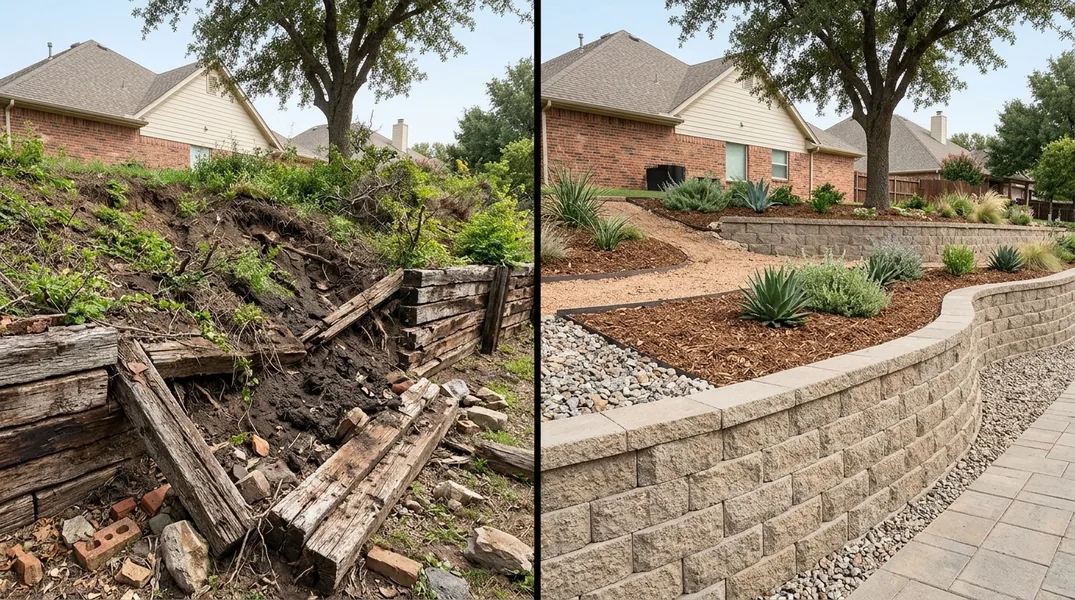
Understanding Dallas Clay and Its Impact on Retaining Walls
If you own property in Dallas, you already know that our clay soil is unique. Unlike sandy or loamy soils found in other regions, Dallas clay expands when wet and contracts when dry, creating tremendous pressure against retaining wall structures. This natural cycle is the primary culprit behind most retaining wall failures in our area.
The problem intensifies during heavy rainfall or extended dry spells. When clay absorbs moisture, it can expand up to 10 percent or more, pushing laterally against the wall with force that poorly designed or poorly maintained structures simply cannot withstand. Conversely, during drought conditions, the soil shrinks and pulls away from the wall, creating gaps and allowing water infiltration that weakens the wall's foundation. This expansion-contraction cycle repeats year after year, gradually degrading even well-built walls that lack proper drainage and reinforcement.
Common Reasons Retaining Walls Fail in North Texas
Retaining wall failures rarely happen overnight. Most walls deteriorate over months or years due to a combination of factors specific to our climate and soil conditions. Poor drainage is the leading cause of failure. When water accumulates behind a retaining wall, hydrostatic pressure builds up, pushing the wall forward and destabilizing its foundation. Many homeowners don't realize that Retaining Wall Installation without proper drainage systems is essentially a ticking time bomb in Dallas clay.
Inadequate compaction during initial installation also contributes significantly to wall failure. If the soil behind the wall wasn't properly compacted in layers during construction, it becomes more susceptible to settling and shifting. Additionally, insufficient reinforcement, improper grading, and walls built without adequate depth or footings all compromise structural integrity. Some older walls were constructed without understanding modern engineering requirements, making them especially vulnerable to clay soil movement. Lastly, tree roots growing behind walls can create voids and further destabilize the structure over time.
Warning Signs Your Retaining Wall Is Failing
Catching retaining wall problems early can prevent expensive damage and potential safety hazards. One of the first visible signs is a leaning retaining wall, where the structure tilts noticeably away from vertical. This indicates soil pressure is overwhelming the wall's lateral resistance. Similarly, a bowing retaining wall fix becomes necessary when the wall's face curves outward, suggesting internal pressure is buckling the structure. These aren't cosmetic issues; they're structural red flags that demand immediate attention.
Watch for horizontal or diagonal cracks in Concrete Retaining Walls or mortar joints, as these suggest stress and movement. Efflorescence (white, powdery deposits) on the wall surface indicates water is seeping through, which weakens the material from inside. If you notice soil or mulch spilling from behind the wall, this suggests the structure is no longer containing the earth properly. Standing water or soggy soil at the wall's base is another warning sign that drainage is failing. Finally, if you see the wall separating from its foundation or notice horizontal displacement at the top compared to the bottom, these are severe indicators requiring professional Retaining Wall Repair immediately.
The Difference Between Leaning and Bowing: Which Is Worse?
Homeowners often confuse leaning and bowing, but understanding the difference helps you assess urgency. A leaning retaining wall tilts uniformly, typically because the entire structure is moving away from the soil pressure. This usually indicates foundation settlement or inadequate base preparation. While serious, leaning walls sometimes can be stabilized through reinforcement and drainage improvements. Bowing, however, is often more dangerous because it means the wall face is buckling under pressure, creating a stress concentration point that can lead to sudden failure.
A bowing retaining wall fix is more complex because the internal structure has already begun to fail. The wall may appear to have only minor outward curvature, but this deformation indicates the material is being overstressed. If bowing continues unchecked, the wall can collapse suddenly without warning. In both cases, professional evaluation is essential. The difference in severity affects whether your wall needs repair, reinforcement, or complete Retaining Wall Replacement. Getting a professional assessment early can mean the difference between a manageable repair and a catastrophic failure.
Professional Retaining Wall Repair Near Me: When to Call the Experts
If you've noticed any warning signs, don't wait to contact professionals. While some minor maintenance tasks can be handled by homeowners, structural issues require licensed contractors with experience in clay soil conditions. Dallas Retaining Wall specializes in diagnosing and repairing walls that have suffered from our region's unique soil challenges. Our team can assess whether your wall needs targeted repairs, comprehensive reinforcement, or full replacement.
The cost of addressing problems early is always less than the cost of emergency repairs or reconstruction. A failing wall can damage adjacent structures, create liability issues, and pose safety risks to family members or neighbors. When you call (469) 436-3386, we'll schedule a site inspection to determine the root cause of failure and recommend the most cost-effective solution. Whether it's improving drainage, adding reinforcement, or rebuilding the wall to modern standards, we have the expertise to handle it. Don't let a failing wall become a crisis; reach out for a free estimate today.
Preventing Future Retaining Wall Failures: Best Practices for Dallas Homeowners
The best approach to retaining wall problems is prevention. If you're planning new construction or replacement, ensure your contractor uses proper drainage systems, including perforated drain tile and gravel backfill. The wall should be built with adequate depth, proper reinforcement, and compacted soil in layers behind it. For existing walls, maintain gutters and downspouts to direct water away from the structure, and ensure grading slopes away from the wall to prevent water pooling. Regular inspection, especially after heavy rain or during seasonal transitions, helps catch problems before they become severe.
Vegetation management is another key factor. While landscaping makes your property attractive, tree roots and heavy plantings can destabilize walls. Keep large trees at a reasonable distance and avoid planting directly behind walls. If you're in Dallas and considering a new retaining wall project, work with contractors who understand clay soil dynamics and design accordingly. Proper Retaining Wall Installation from the start prevents years of headaches and expensive repairs. Dallas Retaining Wall can help you plan, build, or repair your walls with clay soil expertise. Call us at (469) 436-3386 or visit our website to learn more about protecting your investment.
Looking for a professional retaining wall contractor in Dallas? Dallas Retaining Wall responds fast for all your retaining wall needs.
Get a Free QuoteOur services: Retaining Wall Installation · Retaining Wall Repair · Retaining Wall Replacement